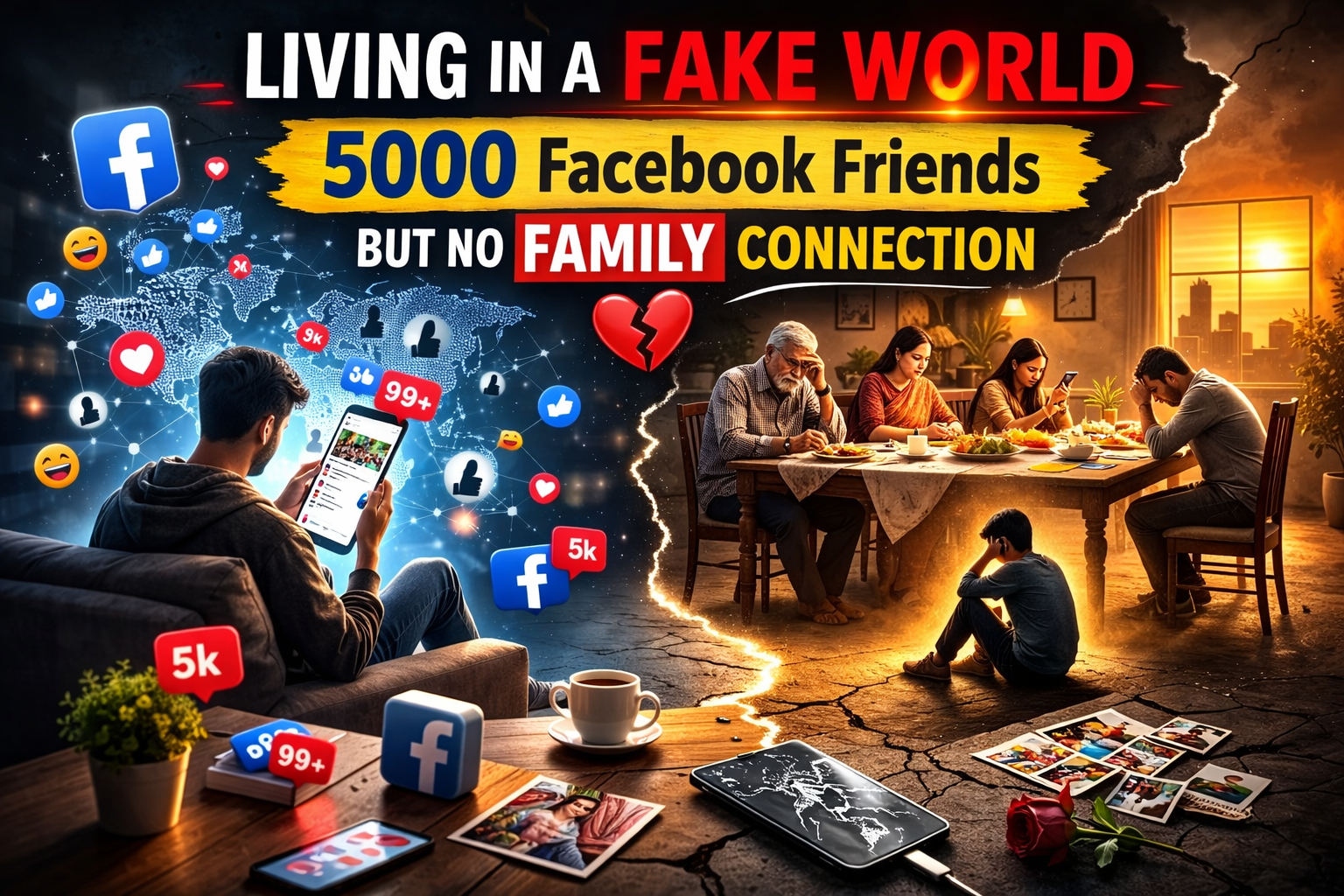
Connected to the World, Disconnected at Home
We live in an age where reaching someone on the other side of the planet takes only a few seconds. A small device in our hands gives us access to thousands of people, endless conversations, and constant updates. We can share our thoughts instantly, upload our memories within moments, and stay informed about everything happening around us.
On the surface, it feels like we have never been more connected.
But if we look a little deeper, we may notice something troubling, while our digital networks are expanding, our real-life relationships are quietly shrinking.
Today, it is common for someone to have thousands of friends on social media. Their photos receive hundreds of likes. Their posts fill with comments within minutes. Birthdays are remembered online with colorful messages and virtual celebrations. Achievements are announced publicly, and moments are shared daily.
Yet behind this constant activity, many of these same individuals rarely sit down for a meaningful conversation with their own family members.
This is the silent contradiction of modern life.
When Online Becomes More Important Than Offline
Social media was originally designed to bring people closer. In many ways, it has achieved that goal. Old classmates reconnect after years. Families separated by distance can see each other’s lives through photos and videos. Information spreads faster than ever before.
But slowly, something shifted.
Instead of supporting real-life connections, online platforms began replacing them.
We now spend evenings scrolling endlessly rather than talking with our parents. We send quick reactions instead of asking someone how they truly feel. We avoid uncomfortable conversations by simply ignoring messages.
Over time, digital communication starts to feel easier than face-to-face interaction.
It becomes normal to chat daily with someone we have never met in person, yet barely exchange words with someone living in the same house.
Without realizing it, we begin prioritizing virtual conversations over real ones.
The Attractive Illusion of Being Popular
There is something undeniably satisfying about receiving attention online. Each like feels like approval. Each comment feels like validation. Watching follower counts increase gives a sense of importance.
It creates a subtle belief that we are valued.
But digital attention is often temporary and surface-level.
A thousand people clicking a heart icon cannot replace one person who truly listens when you are struggling. Hundreds of birthday wishes on your timeline cannot compare to one heartfelt hug from someone who genuinely cares.
Online popularity can be loud and visible.
Real support is often quiet but deeply meaningful.
Social media gives us exposure, but it does not always provide emotional security. It amplifies our presence, but it does not guarantee understanding.
And understanding is what truly strengthens relationships.
The Growing Silence Inside Homes
In many households today, family members share the same physical space but exist in separate digital worlds.
Parents scroll through news feeds in one room. Children watch short videos for hours. Siblings sit next to each other but communicate more with people outside the house than with one another.
Dinner tables, once filled with conversation and laughter, have become quieter. Living rooms no longer echo with shared stories. Instead, the soft glow of screens lights up faces turned downward.
Everyone is occupied.
Everyone is busy.
Yet very little meaningful interaction takes place.
This shift does not happen overnight. It develops gradually. Small moments of disconnection accumulate. Short conversations become shorter. Eye contact becomes rare. Emotional closeness slowly weakens.
And often, no one realizes it until the distance feels too wide to easily close.
Why Virtual Life Feels Easier
One reason many people retreat into digital spaces is comfort.
Online, we control the narrative. We decide what to show and what to hide. We present carefully selected moments rather than the full reality of our lives.
We can edit our photos, rewrite our thoughts, and delete messages before anyone sees them. We avoid awkward pauses and difficult discussions. If something feels uncomfortable, we can simply log out.
Real-life relationships, especially within families, do not offer that same control.
Family members see our imperfections. They witness our moods, our weaknesses, and our mistakes. They expect honesty and responsibility, not a polished version of ourselves.
That vulnerability can feel challenging.
So instead of facing complicated emotions, some people choose the easier path, escaping into the safer world of digital interaction.
But what feels comfortable in the short term may create emotional distance in the long term.
The Hidden Cost of Emotional Distance
Neglecting real-life relationships does not cause immediate damage. At first, everything appears normal. People still live together. They still share routines. Life continues.
But slowly, subtle cracks begin to form.
Conversations become brief and practical rather than meaningful. Misunderstandings remain unresolved. Emotional support weakens because fewer genuine discussions take place.
When serious challenges arise, stress at work, personal failure, illness, heartbreak, online friends may respond with messages of sympathy. But it is usually family members who provide real, tangible support.
They are the ones who stay during difficult times, who sit beside you in silence, who offer strength without expecting anything in return.
If emotional bonds have been neglected for too long, rebuilding them during moments of crisis becomes much harder.
Connection requires consistent care.
Without it, relationships slowly fade.
Technology Is Not the Enemy
It is important to clarify that social media itself is not inherently harmful. Technology is simply a tool.
It allows distant relatives to stay connected. It helps people share joyful moments. It provides access to information and opportunities.
The issue arises when digital interaction replaces face-to-face communication instead of complementing it.
When scrolling consumes the time that could have been spent talking.
When notifications interrupt conversations.
When virtual validation becomes more important than real-world presence.
The issue is not the existence of technology.
Rather, the real concern is imbalance.
The problem is imbalance.
Real Relationships Require Effort
Strong family bonds do not grow automatically. They require intention.
They are built through
Honest conversations
Shared experiences
Active listening
Patience during disagreements
Emotional support during hardship
These elements cannot be substituted with emojis, status updates, or short comments.
Trust develops through consistency.
Love strengthens through presence.
Understanding deepens through time spent together.
No digital platform can fully replicate those experiences.
Small Steps Toward Reconnection
The encouraging truth is that repairing and strengthening real-life relationships does not require dramatic changes.
Often, small actions make the biggest difference.
Put away devices during meals.
Ask meaningful questions about each other’s day.
Listen without glancing at a screen.
Share thoughts openly without fear of judgment.
Spend time together without the distraction of notifications.
Even simple moments, sitting together quietly, walking outside, or sharing a cup of tea, can restore emotional closeness.
Reconnection begins with awareness.
It continues with effort.
Finding Balance in a Digital World
The modern world will continue to evolve technologically. Digital communication is not disappearing, nor should it. It has many benefits.
But a fulfilling life cannot exist solely online.
Balance is essential.
Stay connected with friends across the globe, but do not overlook the people in the same room.
Celebrate achievements publicly, but also share private conversations with loved ones.
Enjoy social platforms, but set boundaries that protect your real-life relationships.
Having a wide network may be impressive.
Having deep, meaningful connections is priceless.
A Final Reflection
Thousands of online friends may create the appearance of popularity.
But genuine emotional support usually comes from a much smaller circle.
Social media can entertain us, inform us, and connect us temporarily.
Family relationships sustain us.
In times of silence, they understand without needing explanations.
In a world filled with constant digital noise, what truly matters are the quiet conversations, the shared laughter, the patient listening, and the steady presence of those who care deeply.
Because when life becomes difficult, when the applause fades and the notifications stop, it is not the number of reactions on a post that brings comfort.
It is the people who sit next to you, hold your hand, and remind you that you are not alone.
And that kind of connection cannot be measured in likes.

